Products for building
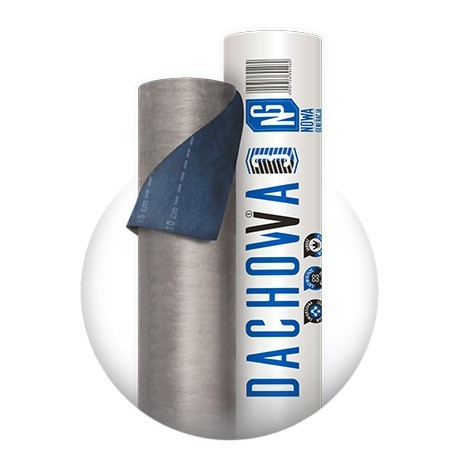



Roofing membranes are used as an underlayment for pitched roofs. They prevent wind-driven precipitation (rain and snow) from penetrating into the thermal insulation and roof structure. They provide protection against condensation forming under the primary roofing.
Additionally, thanks to their high vapour permeability, they keep the entire roof dry, which is very important for a building's energy consumption


Advantages:
- High and uniform vapour permeability
- Great flexibility and light weight, which facilitate installation
- Waterproofness, ensuring a watertight roof
- High mechanical strength
- High resistance to UV radiation
- Wide product range, making it easier to choose the right membrane
- Comprehensive information, guaranteeing correct application
| PARAMETER | VALUE |
| Material | polypropylene - 3 layers |
| Mass [g/m²] | 150 ±20 |
| Sd – equivalent air layer thickness [m] | 0.015 (+0.03/-0.01) |
| Tensile strength [N/5cm] | lengthwise: 320 (+60/-80) crosswise: 210 (+60/-80) |
| Elongation at break [%] | lengthwise: 90 (±50) crosswise: 110 (±50) |
| Nail tear resistance [N] | lengthwise: 200 (±90) crosswise: 270 (±90) |
| Water tightness class | W1 |
| Fire resistance class | E |
| Roll dimensions [m] | width 1.6 m × length 50 m |
| UV resistance* | 26 weeks |
| Period without main covering** | 3 weeks |
* According to laboratory studies conducted under artificial aging, this period is based on average annual UV exposure from sunlight in Central Europe.
** The period for which the membrane remains on the roof without the primary covering should be as short as possible; the more sunny days there are, the shorter this period should be.






© 2026 Marma Polskie Folie